Entre Normandie, Flandres, Provinces Unies…
The programme “Les Voyages d’Orphée” was proposed, conceived and designed by Thomas van Essen, musical director of the ensemble Les Meslanges, following various discussions in preparation for the 2027, European year of the Normans celebrations. Contact was made with Bart Demuyt, director of AMUZ and Laus Polyphoniae in Antwerp, Belgium, who appreciates the ensemble’s work, and this was decisive for the future of the project.
With “Les Voyages d’Orphée” fitting perfectly with the theme of the festival “Voices of Europe circa 1600. Continent of counterpoint”, taking place in August 2026, it was agreed to create this programme ahead of the 2027 Normandy celebrations and to give its first performance in Antwerp on 22 August 2026.
Director’s note
In the 1600s, at the end of the Renaissance and the dawn of the 17th century, being compared to Orpheus was a privilege enjoyed by great musicians. This musical programme highlights the travels of musicians and the dissemination of works between Normandy, Flanders and the United Provinces.
Although Flanders belonged to the Kingdom of Spain at that time, the United Provinces in the north were increasingly asserting their religious and political autonomy. Despite the unrest, musicians travelled widely: the organist and composer Titelouze left Saint-Omer, then in the Spanish Netherlands, to settle permanently in Rouen.
In this programme, the works of Lassus, Titelouze, Sweelinck and other ‘new Orpheuses’* will interact and illustrate the fruitful exchanges between Normandy and the northern countries. Titelouze and Lassus, the latter having travelled throughout Europe, both composed on the hymn of Ave Maris Stella intended for alternatim (alternation between two formations in liturgical singing). The Rouen Cathedral owned a number of works by Lassus sung by the ‘Maîtrise’. In converging these two great masters, we illustrate the mobility of works and musicians.
The organ will feature prominently in this programme, an instrument that was neglected during this period, particularly in France. At that time, “its stops were more polyphonic, more suited to playing the vocal repertoire. This organ, promoted by Jehan Titelouze, was surely among the most flexible, magnificent and effective that northern France had ever known. […] Paradoxically, this region of Normandy-Flanders is very rich in vocal music but very poor in organ music. It seems that organists continued to play vocal music without feeling the need to write adaptations for the organ, arranging and diminishing it as they saw fit.” 1
Titelouze and his contemporary Sweelinck were also aware of the upheavals coming from Italy: the spread of music printing and the travels of musicians facilitated this enrichment. The Netherlands, Flanders, Normandy: in time and space, ‘transition’ started from the Renaissance to the Baroque…
*The programme may be adapted to include a piece in English (or another language, depending on the possibilities available in each country) within the work, upon discussion with the artistic directors.
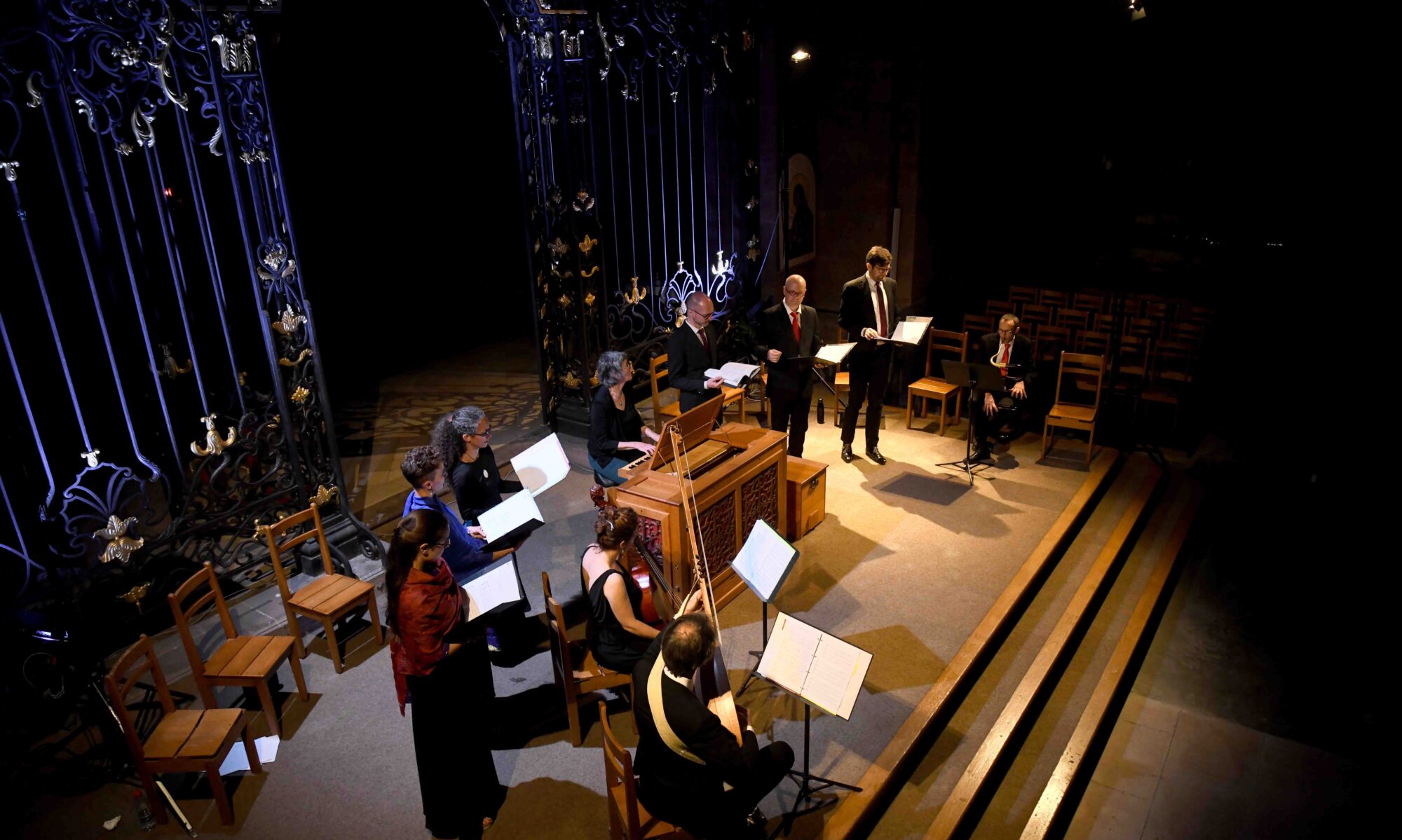
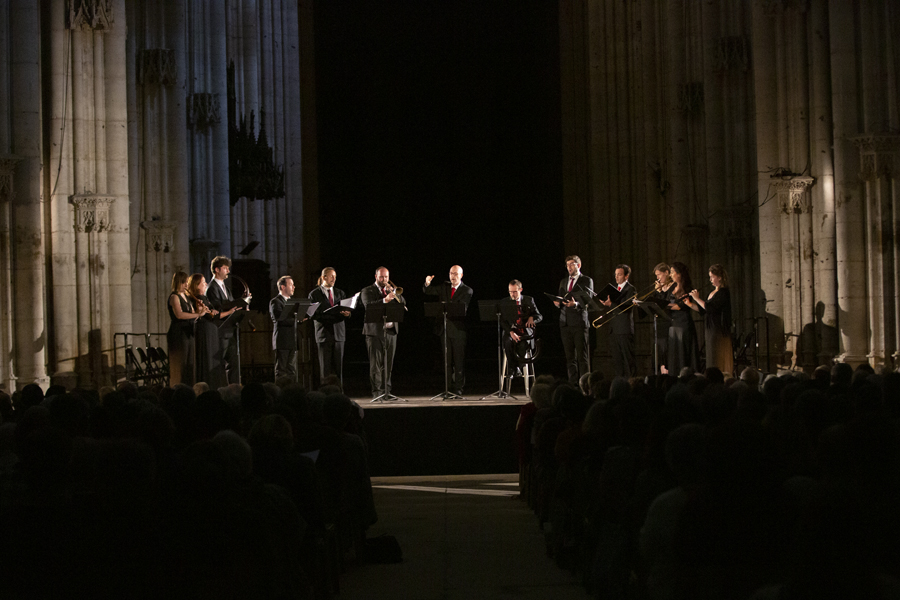
Distribution in progress: 7 singers, 6 instrumentalists (cornets, sackbuts, serpent), 1 organist
Musical direction: Thomas van Essen & Volny Hostiou
Broadcast
FIRST PUBLIC PERFORMANCE – August, Saturday 22nd 2026
Laus Polyphoniae – AMUZ
Anvers (Belgium)
Photos
©Jeff Lescène